
Canva · Visual Design · Instructional Theory
Learning Technology
Infographic
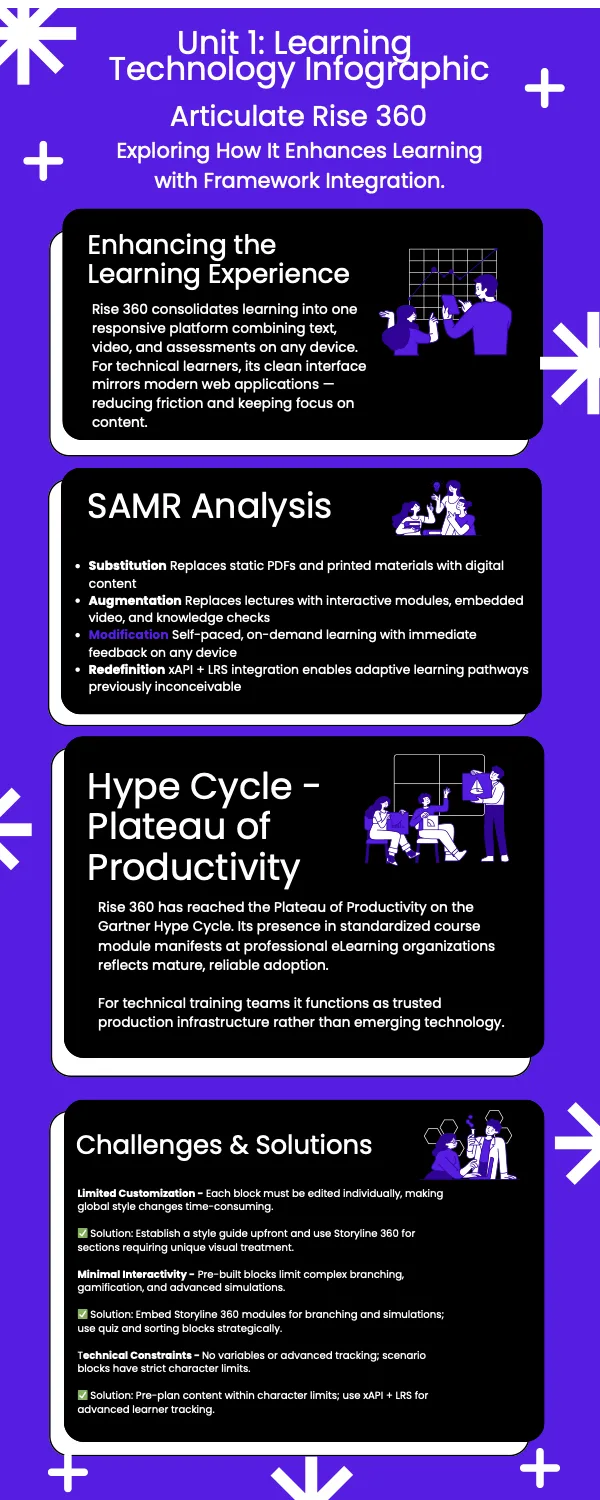
A visual synthesis of key learning technology frameworks — including SAMR, the Hype Cycle, and Articulate Rise 360 — designed in Canva as the Unit 1 assignment for LDTC 620.
The Assignment
Communicating theory through design
As part of LDTC 620 — a graduate course in the M.S. Learning Design and Technology program at UMGC — I was tasked with creating an infographic that synthesized foundational learning technology concepts into a clear, visually engaging deliverable.
The assignment challenged me to move beyond written analysis and communicate complex instructional theory through layout, hierarchy, and visual metaphor — skills that transfer directly into eLearning development and instructional communication.
I designed this infographic entirely in Canva, applying intentional color, typography, and visual structure to make the content accessible and compelling.
Content
Frameworks Covered
The infographic synthesizes four interconnected learning technology concepts into a cohesive visual narrative.
Articulate Rise 360
Explored how Rise 360 transforms traditional eLearning into responsive, mobile-first experiences — and how it integrates with Bloom's Taxonomy to structure learning activities.
SAMR Model
Illustrated the four levels of technology integration — Substitution, Augmentation, Modification, and Redefinition — and how each level changes the nature of learning tasks.
Hype Cycle — Plateau of Productivity
Applied the Gartner Hype Cycle to educational technology adoption, positioning Rise 360 within the Plateau of Productivity as a mature, trusted tool for digital learning.
Challenges & Solutions
Addressed real-world barriers to technology integration in learning contexts — including access, training, and resistance to change — and paired each with practical instructional solutions.
Design Process
Structure, hierarchy, and intentional color
I approached this infographic the same way I approach any instructional artifact — starting with the learning objective and working backward to the design. The goal was to help a viewer understand the relationship between these frameworks in a single glance, then drill deeper through the visual hierarchy.
The dark-background layout with high-contrast purple and teal tones was a deliberate choice to give the piece a modern, professional aesthetic consistent with technology-focused instructional materials. Each section is visually distinct but unified through consistent typography and color language.
"Start with the learning objective and work backward to the design."
Reflection
Visual design as instructional communication
This project demonstrates skills that transfer directly into eLearning development, job aids, and performance support design.
Visual Storytelling
Translating abstract instructional theory into a clear, scannable visual narrative — the same skill behind effective eLearning UI and infographic-style job aids.
Content Synthesis
Distilling complex frameworks into concise, accurate summaries requires deep conceptual understanding — not just design proficiency.
Tool Fluency
Canva is widely used in EdTech and corporate training contexts for rapid visual content creation. This project demonstrates professional-level fluency with the platform.
Deliverable
View the Full Infographic
Download the original PDF to view the infographic at full resolution.
Download PDFKeep Exploring
More from LDTC 620
AI Learning Tool
ChatGPT as an AI-Powered Learning Tool — UMGC LDTC 620
An analysis of ChatGPT as a learning tool — evaluating its potential for personalized instruction, formative feedback, and learner scaffolding within formal educational contexts.
Social & Collaborative Learning
Social & Collaborative Learning Spaces — UMGC LDTC 620
An exploration of social and collaborative learning technologies — analyzing how platforms support peer interaction, knowledge construction, and community-based learning in formal and informal settings.
Interested in working together?
I'm currently available for remote instructional design and eLearning development contracts.