
Guest Speaker · Inclusive Design · Mentoring
Mentoring Students
with Disabilities
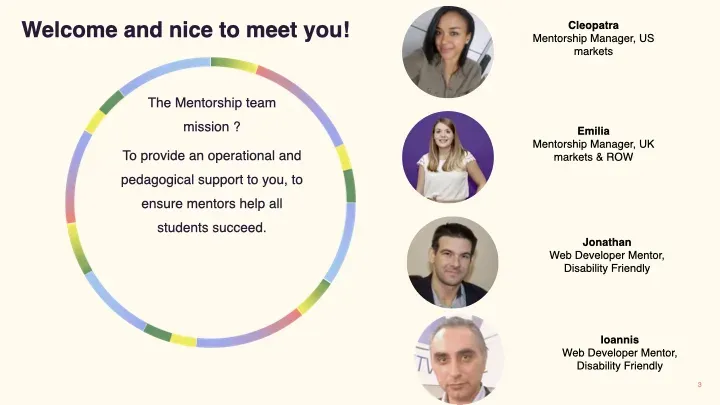
Invited as a guest speaker for an OpenClassrooms internal webinar on mentoring learners with disabilities — sharing practical strategies, case studies, and inclusive teaching approaches drawn from direct mentoring experience.
The Invitation
Recognized as a Disability Friendly mentor
In June 2024, OpenClassrooms — a Paris-based online learning platform serving over 500,000 learners — invited me to speak at an internal webinar for their global mentor community on the topic of mentoring students with disabilities.
I was designated a Disability Friendly Web Developer Mentor at OpenClassrooms, meaning I was specifically paired with students who had declared learning disabilities — including ADHD, dyslexia, visual impairment, and chronic illness. That hands-on experience formed the basis of my contribution to the webinar.
The full webinar was organized by the OpenClassrooms Mentorship team and covered disability types, legal accommodations, inclusive platform tools, and assessment facilitation. I presented the practitioner perspective — real strategies from real sessions — to an audience of 49 registered attendees.
49
registered attendees
June 2024
OpenClassrooms Global Mentor Community
Guest Speaker — Practitioner Perspective
My Presentation
What I covered
My section focused on the practical, day-to-day experience of mentoring web development students with a wide range of learning disabilities.
Mindset & Inclusion
Why every learner belongs in tech — and how working with students with disabilities gives mentors a deeper sense of purpose in the learning journey.
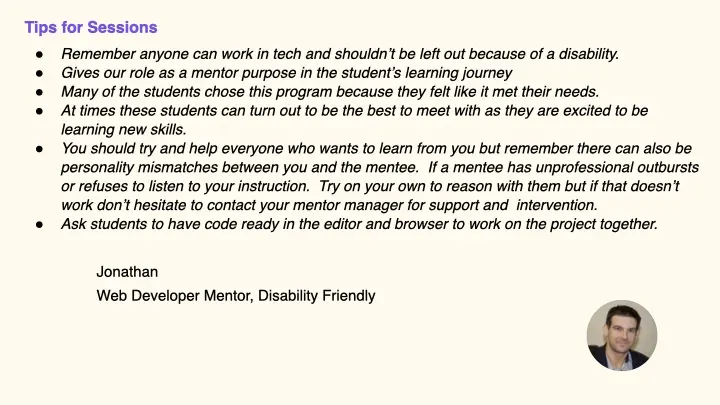
Tips for Sessions
Practical guidance for structuring mentoring sessions: managing personality mismatches, keeping students engaged, and knowing when to escalate to a mentor manager.
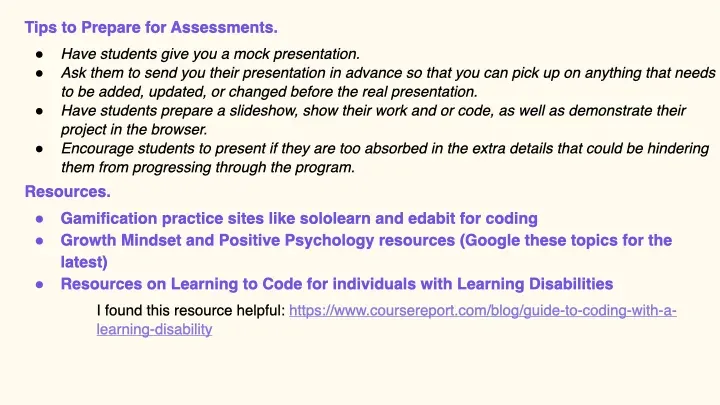
Assessment Preparation
How to run mock presentations, review deliverables in advance, use slideshows and live demos to reduce anxiety, and help students build confidence before assessments.
Case Studies
Three real case studies from my mentoring practice: structured sessions for ADHD, YouTube-based learning for possible dyslexia, and individualized learning plans for sustained progress.
Assistive Technology
Recommended tools including natural language audio readers, real-time transcription services, screen readers, and apps like Seeing AI and Be My Eyes.
Recommended Training
Curated mentor training resources covering Universal Design for Learning (UDL), disability sensitivity, effective communication strategies, and assistive technology implementation.
Case Studies
Strategies drawn from real sessions
Student with ADHD — Structured Sessions
Designed sessions around short, focused activities interspersed with brief breaks. The student showed improved focus and productivity, demonstrating better retention of material over time.
Student with Possible Dyslexia — Assistive Technology
Incorporated YouTube video walkthroughs as a primary learning medium. The student completed projects more efficiently and with less frustration, and their deliverable quality and confidence improved.
Individualized Learning Plan — Sustained Progress
Collaborated with a student to develop a tailored IEP with specific strategies and goals. Consistent support across different settings led to steady academic progress and improved self-esteem.
"Anyone can work in tech and shouldn't be left out because of a disability."
Webinar Recording
Watch My Presentation
Edited from the full one-hour webinar recording using Final Cut Pro.

Reflection
Inclusive design begins with the mentor
Working with students with disabilities at OpenClassrooms reshaped how I think about learning design at every level. When a student's success depends on how well you adapt — your pacing, your tools, your communication style — you develop a much sharper instinct for what actually works in instruction.
The same principles that make a good mentoring session for a student with ADHD — clear structure, focused chunks, regular feedback — are the same principles that make good eLearning for everyone. Inclusive design isn't a special case. It's just good design.
Being invited to share this perspective with OpenClassrooms' global mentor community was a meaningful recognition of that work.
Presented as a guest speaker at the OpenClassrooms internal webinar, June 2024.
Interested in working together?
I'm currently available for remote instructional design and eLearning development contracts.